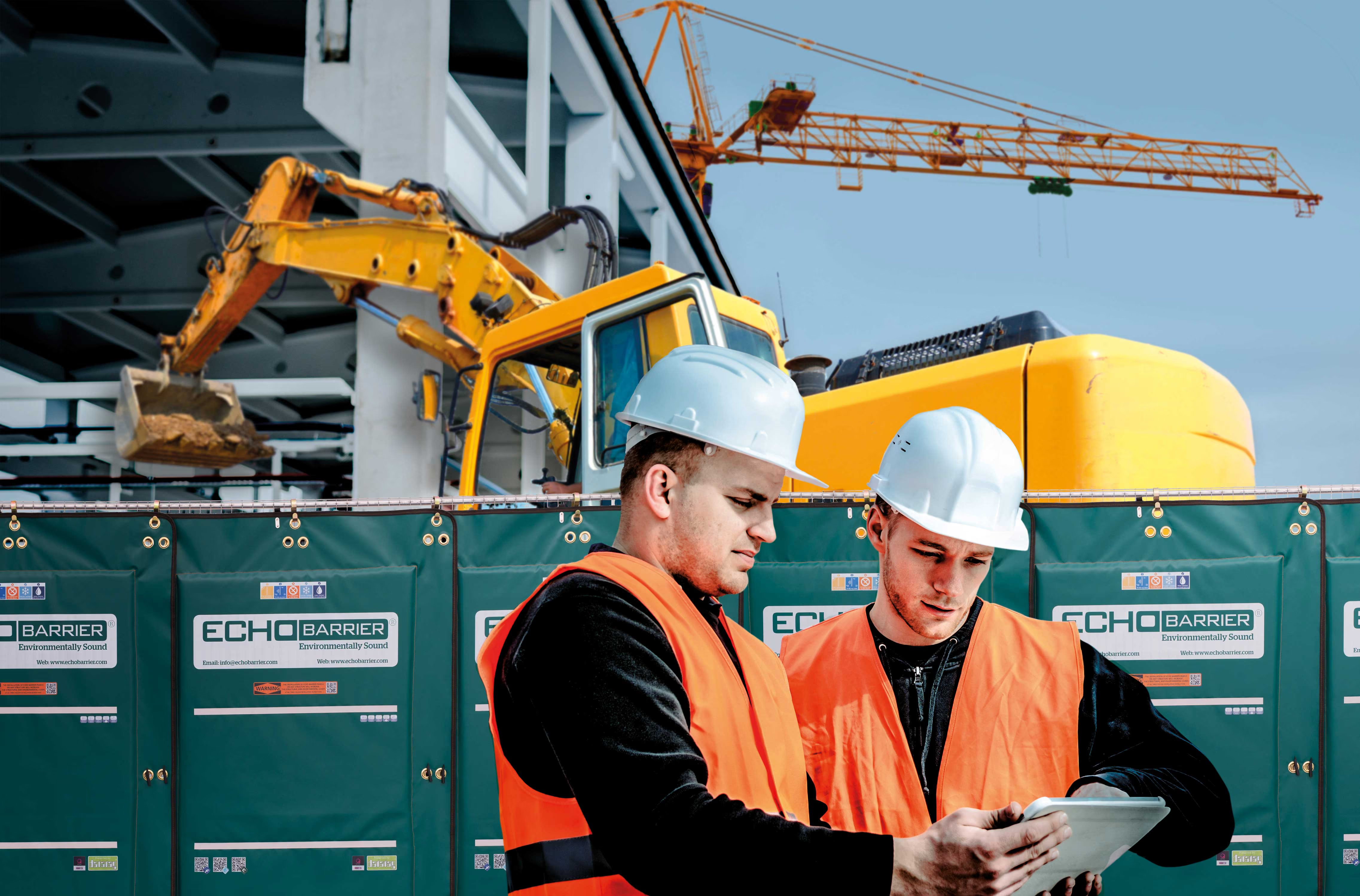
Construction Noise Barriers for San Francisco Job Sites
Comply with SF Police Code §2907 and Article 29. 43 dB noise reduction. Same-week distribution to the Bay Area.

Local regulation overview
San Francisco's Strictest-in-the-Nation Construction Noise Code
San Francisco enforces one of the most demanding construction noise regulations in the United States. The city's Police Code — specifically Sections 2907 and 2908 under Article 29 — sets clear decibel limits and equipment-specific requirements that every contractor working in the Bay Area must understand.
Section 2907(a) limits all powered construction equipment to a maximum of 80 dBA measured at 100 feet. This is notably stricter than New York City's threshold of 85 dBA at 50 feet. Standard unmitigated jackhammers (100–110 dBA), concrete saws (95–105 dBA), and pile drivers (95–115 dBA) will exceed the legal limit without active noise mitigation in place.
Section 2907(b) goes further with a statutory requirement that is unique among US cities: pavement breakers and jackhammers must be equipped with acoustically attenuating shields or shrouds recommended by the manufacturer and approved by the Director of Public Works.
Enforcement is multi-agency. The Department of Building Inspection (DBI), Department of Public Works (DPW), and Department of Public Health (DPH) all act on construction noise complaints, which means resolution timelines are faster in San Francisco than in single-agency cities.
80 dBA at 100 ft — Maximum noise level for powered equipment
$500 / day — Civil penalty per violation
300 ft — Buffer zone from residential / school / hospital
7 AM – 8 PM — Permitted hours (daily)
Ordinance: SF Police Code §§2907, 2908 — Article 29 (Regulation of Noise)
Enforcement: SF Department of Building Inspection · Department of Public Works · Department of Public Health
Regulatory information last verified from public sources. Confirm with enforcing agency.
Noise Limit
Max penalty
Buffer / trigger
Work hours
Echo Barrier solution
for city job sites
Noise reduction
AKRF tested
Per panel
Distribution
Acoustic Barriers Designed for Urban Construction
Echo Barrier's portable acoustic barrier system is purpose-built for the demands of urban construction noise control. Lightweight, reusable, and deployable in hours rather than days, the system provides independently verified noise reduction performance that satisfies §2907(b) shield requirements and the broader Article 29 mitigation framework.
43 dB — Noise reduction
STC 30 — AKRF field tested
13 lbs — Per panel
Same week — Bay Area distribution
How Echo Barrier deploys on San Francisco job sites
Across SoMa, the Mission District, the Financial District, the Tenderloin, and Richmond, contractors deploy Echo Barrier panels around jackhammers, concrete saws, generators, and pile-driving operations. The panels' 13-lb weight allows a two-person crew to install perimeter mitigation in hours, compared with the multi-day install required for 1.5-inch marine plywood hoarding of equivalent height.
On Bay Area high-rise refurbishment and Muni / BART trackside work, Echo Barrier's reusable system has been deployed across multiple consecutive sites, reducing cumulative mitigation cost compared with single-use plywood. The panels also satisfy the DPW Night Noise Authorization Permit requirement to demonstrate documented mitigation controls for after-hours work.
43 dB noise reduction and STC 30 performance verified by AKRF Engineers in independent field testing on New York City construction sites, October 2021. Actual on-site noise reduction varies based on installation method, equipment type, panel coverage area, site geometry, ambient conditions, and distance to receptor. The full AKRF test report (with methodology and measurement conditions) is available via the Download Free AKRF Report button on this page.
§2907(b) of the SF Police Code requires acoustic shields to be "recommended by the manufacturers thereof and approved by the Director of Public Works." Contractors should confirm with DPW that the specific Echo Barrier configuration intended for deployment meets the Director's approval for their site, equipment, and permit conditions.
Performance claims vary by site conditions and installation.
Ready to Stay Compliant? Get Your Free Quote Today
Echo Barrier's portable acoustic barriers reduce construction noise by up to 43 dB — helping you meet local regulations and avoid costly fines.
Echo Barrier vs plywood hoarding
See Why Contractors Choose Echo Barrier
Lightweight, reusable, and proven to cut noise by 43 dB. Request your free site assessment and learn how Echo Barrier keeps your projects on schedule.
City-specific compliance detail
Night construction and DPW permit requirements
Section 2908 of the SF Police Code restricts nighttime construction between 8:00 PM and 7:00 AM. Any construction during these hours that exceeds +5 dBA above ambient noise at the nearest property plane requires a Night Noise Authorization Permit from the Director of Public Works. In practice, virtually all powered construction equipment exceeds this threshold, meaning that after-hours work in San Francisco requires both a DPW permit and a documented noise management plan.
The SF Port's standard Night Noise Authorization Permit form requires contractors to implement mitigation controls and limits all powered equipment to 80 dBA at 100 feet. DPW permit reviewers routinely include conditions requiring temporary acoustic barriers, sound blankets, and detailed noise management plans as part of the permit approval. Contractors who cannot demonstrate adequate noise mitigation will not receive permit approval for after-hours work.
The 300-foot residential buffer requirement
For projects within 300 feet of residential, elder care, medical campus, school, or hospital buildings, the use of temporary construction noise barriers or sound blankets is mandatory according to SF DPW construction management guidance. This 300-foot buffer covers a significant portion of construction activity in San Francisco's densely built neighborhoods.
§2907(b) — the jackhammer and pavement-breaker shield rule
Section 2907(b) is unusual in US municipal code: it explicitly names "pavement breakers and jackhammers" and requires them to be equipped with acoustically attenuating shields or shrouds. The rule is statutory, not advisory. Contractors operating impact tools in San Francisco without acoustic shields are non-compliant regardless of whether their site is exceeding the 80 dBA limit at the time of inspection.
Echo Barrier's portable panels function as the acoustic shield for this requirement when correctly positioned around the operating equipment. Independent AKRF field testing documents up to 43 dB of reduction at the panel face, providing a substantial margin against the 80 dBA at 100 ft limit for typical jackhammer operations.
Penalties and enforcement reach
Civil penalties for noise violations under Article 29 begin at $500 per day. The City Attorney is authorized to recover attorney's fees in addition to the civil penalty, which can substantially increase the practical cost of a sustained violation. Because three agencies (DBI, DPW, DPH) each have enforcement authority, a single complaint can trigger inspections from multiple departments — a structural difference from cities where one agency owns the entire complaint pipeline.
Practical compliance checklist for SF contractors
- Confirm your project's distance from residential, school, medical, or elder-care buildings (300 ft buffer triggers mandatory barriers).
- If any work is planned outside 7 AM – 8 PM, secure a DPW Night Noise Authorization Permit and document mitigation controls.
- For jackhammers and pavement breakers, confirm shield approval with the Director of Public Works under §2907(b).
- Maintain a written noise management plan accessible on site for DBI / DPW / DPH inspection.
- Document barrier placement, equipment type, and ambient noise readings — useful if a complaint is filed.
Frequently asked questions
Plywood hoarding typically achieves around 20 dB of noise reduction (STC 18–22) and weighs 45+ lbs per sheet. Echo Barrier panels deliver up to 43 dB (STC 30) at 13 lbs per panel and are reusable across multiple job sites. The 2021 AKRF field comparison documents these performance differences under controlled conditions.
Yes — Echo Barrier is commonly deployed as part of the mitigation controls documented in DPW Night Noise Authorization Permit applications. The Night Noise Authorization Permit requires contractors to demonstrate noise management measures, and Echo Barrier panels are routinely accepted as a qualifying mitigation control.
Civil penalties under Article 29 begin at $500 per day per violation. The City Attorney is authorized to recover attorney's fees in addition to the civil penalty. Because three agencies (DBI, DPW, DPH) each enforce noise rules, a complaint can trigger inspections and compounded enforcement action across departments.
Yes. Echo Barrier ships to San Francisco and the wider Bay Area on a same-week basis through regional logistics partners. We do not operate a local office in San Francisco; sales and technical support are available via the local number listed on this page.
§2907(b) requires acoustic shields on pavement breakers and jackhammers, recommended by the manufacturer and approved by the SF Director of Public Works. Echo Barrier's portable acoustic panels function as the required shield when correctly positioned around the operating equipment. Contractors should confirm specific configuration approval with DPW for their site and permit conditions.
Echo Barrier panels provide up to 43 dB of noise reduction at the panel face, with an STC 30 rating, as verified by independent AKRF field testing on New York City construction sites in 2021. Real-world on-site reduction varies with installation, equipment type, site geometry, and distance to receptor — the AKRF report (linked from this page) details measurement conditions.
Construction noise in San Francisco is governed primarily by SF Police Code §§2907 and 2908, together known as Article 29. The code sets an 80 dBA limit at 100 feet for powered equipment, restricts work outside 7 AM – 8 PM, requires acoustic shields on jackhammers and pavement breakers, and mandates temporary noise barriers within 300 feet of residential, medical, school, or elder-care buildings. Enforcement is shared by DBI, DPW, and DPH.
Plan a §2907-compliant San Francisco job site
Download the independent AKRF test report, or request a free quote tailored to your Bay Area project.